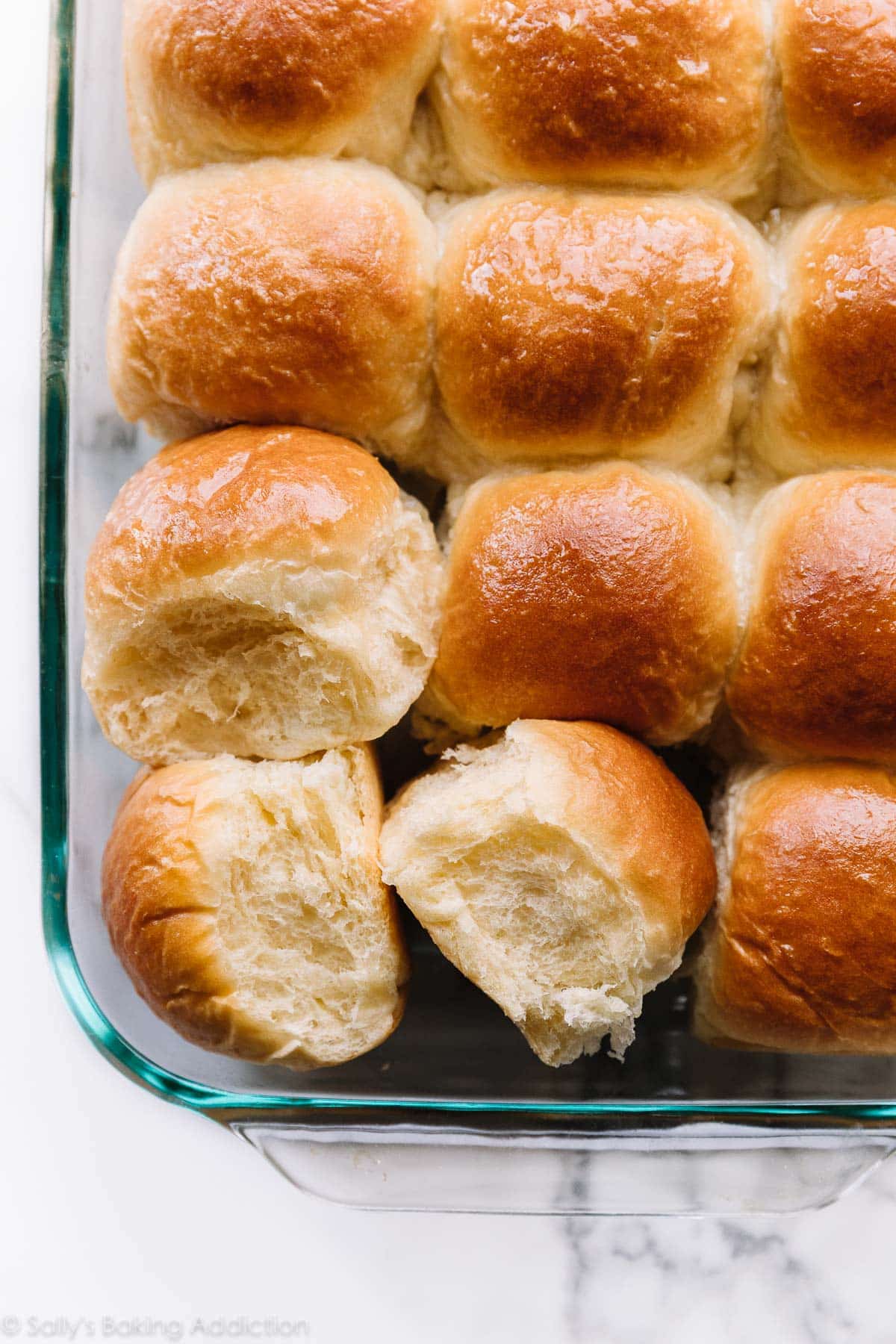
You only need 7 ingredients to make these dinner rolls. Flaky, soft, and buttery, these fresh dinner rolls outshine any main dish. See recipe notes for freezing and overnight instructions. You can also reference my Baking with Yeast Guide for answers to common yeast FAQs. This recipe is also in my cookbook, Sally's Baking 101.
Recipe by Sally on April 2, 2019
Prep time: PT3H25M
Cook time: PT22M
Total time: PT3H45M
Rating
4.8 stars ( reviews)
Keywords
bread, rolls, yeast rolls
Ingredients
1 cup (240ml) whole milk, warmed to about 110°F (43°C)
2 and 1/4 teaspoons Platinum Yeast from Red Star instant yeast (1 standard packet)
2 Tablespoons granulated sugar, divided
1 large egg
1/4 cup (4 Tbsp; 56g) unsalted butter, softened to room temperature and cut into 4 pieces
1 teaspoon salt
3 cups (390g) all-purpose flour or bread flour* (spooned & leveled)
Whisk the warm milk, yeast, and 1 Tablespoon of sugar together in the bowl of your stand mixer. Cover and allow to sit for 5 minutes. *If you do not own a stand mixer, you can do this in a large mixing bowl and in the next step, mix the dough together with a large wooden spoon/silicone spatula. It will take a bit of arm muscle. A hand mixer works, but the sticky dough repeatedly gets stuck in the beaters. Mixing by hand with a wooden spoon or silicone spatula is a better choice.*
Add the remaining sugar, egg, butter, salt, and 1 cup flour. With a dough hook or paddle attachment, mix/beat on low speed for 30 seconds, scrape down the sides of the bowl with a silicone spatula, then add the remaining flour. Beat on medium speed until the dough comes together and pulls away from the sides of the bowl, about 2 minutes. If the dough seems too wet to a point where kneading (next step) would be impossible, beat in more flour 1 Tablespoon at a time until you have a workable dough, similar to the photos above. Dough should be soft and a little sticky, but still manageable to knead with lightly floured hands.
Keep the dough in the mixer and beat for an additional 5 full minutes, or knead by hand on a lightly floured surface for 5 full minutes. (If you’re new to bread-baking, my How to Knead Dough video tutorial can help here.) If the dough becomes too sticky during the kneading process, sprinkle 1 teaspoon of flour at a time on the dough or on the work surface/in the bowl to make a soft, slightly tacky dough. Do not add more flour than you need because you do not want a dry dough. After kneading, the dough should still feel a little soft. Poke it with your finger—if it slowly bounces back, your dough is ready to rise. You can also do a “windowpane test” to see if your dough has been kneaded long enough: tear off a small (roughly golfball-size) piece of dough and gently stretch it out until it’s thin enough for light to pass through it. Hold it up to a window or light. Does light pass through the stretched dough without the dough tearing first? If so, your dough has been kneaded long enough and is ready to rise. If not, keep kneading until it passes the windowpane test.
Lightly grease a large bowl with oil or nonstick spray. Place the dough in the bowl, turning it to coat all sides in the oil. Cover the bowl with aluminum foil, plastic wrap, or a clean kitchen towel. Allow the dough to rise in a relatively warm environment for 1-2 hours or until double in size. (I always let it rise on the counter. Takes about 2 hours. For a tiny reduction in rise time, see my answer to Where Should Dough Rise? in my Baking with Yeast Guide.)
Grease a 9×13 inch baking pan or two 9-inch square or round baking pans. You can also bake the rolls in a cast iron skillet or on a lined baking sheet.*
When the dough is ready, punch it down to release the air. Divide the dough into 14-16 equal pieces. (Just eyeball it– doesn’t need to be perfect!) A bench scraper is always helpful for cutting dough. Shape each piece into a smooth ball. Arrange in prepared baking pan.
Cover shaped rolls with aluminum foil, plastic wrap, or a clean kitchen towel. Allow to rise until puffy, about 1 hour.
Adjust oven rack to a lower position and preheat oven to 350°F (177°C). (It’s best to bake the rolls towards the bottom of the oven so the tops don’t burn.)
Bake for 20-25 minutes or until golden brown on top, rotating the pan halfway through. If you notice the tops browning too quickly, loosely tent the pan with aluminum foil. Remove from the oven, brush with optional honey butter topping, and allow rolls to cool for a few minutes before serving.
Cover leftover rolls tightly and store at room temperature for 2-3 days or in the refrigerator for up to 1 week.
Reviews
Sheri Sidwell on 2026-03-21 (5 stars): I love these plain, but I think I'll try the Sweet Potato for Easter this year. Doesn't that sound good with ham? And if there are any left, ham-n-cheese sliders? You know what? I don't think I'll wait for Easter!
Suzie B on 2026-03-22 (3 stars): I was disappointed. It went quickly and easily, but I think there's not enough salt in the recipe, because they turned out kind of blah.
Terry on 2026-03-29 (5 stars): These are incredible, so tasty & your instructions snd videos are so clear its hard for even me to mess it up! I’ve always wanted to bake bread, started back in January following your recipes, you’ve made it possible! God bless you.
Jessica on 2026-03-29 (4 stars): These are delicious. I made them as the base for homemade breakfast sandwiches. And I made them into 12 not 14+. So the cook time took longer than mentioned above. Other than that they are the perfect yeasty bun!
Rich on 2026-03-30 (5 stars): Love this recipe. I use it to make hamburger buns as well. So soft and tasty.